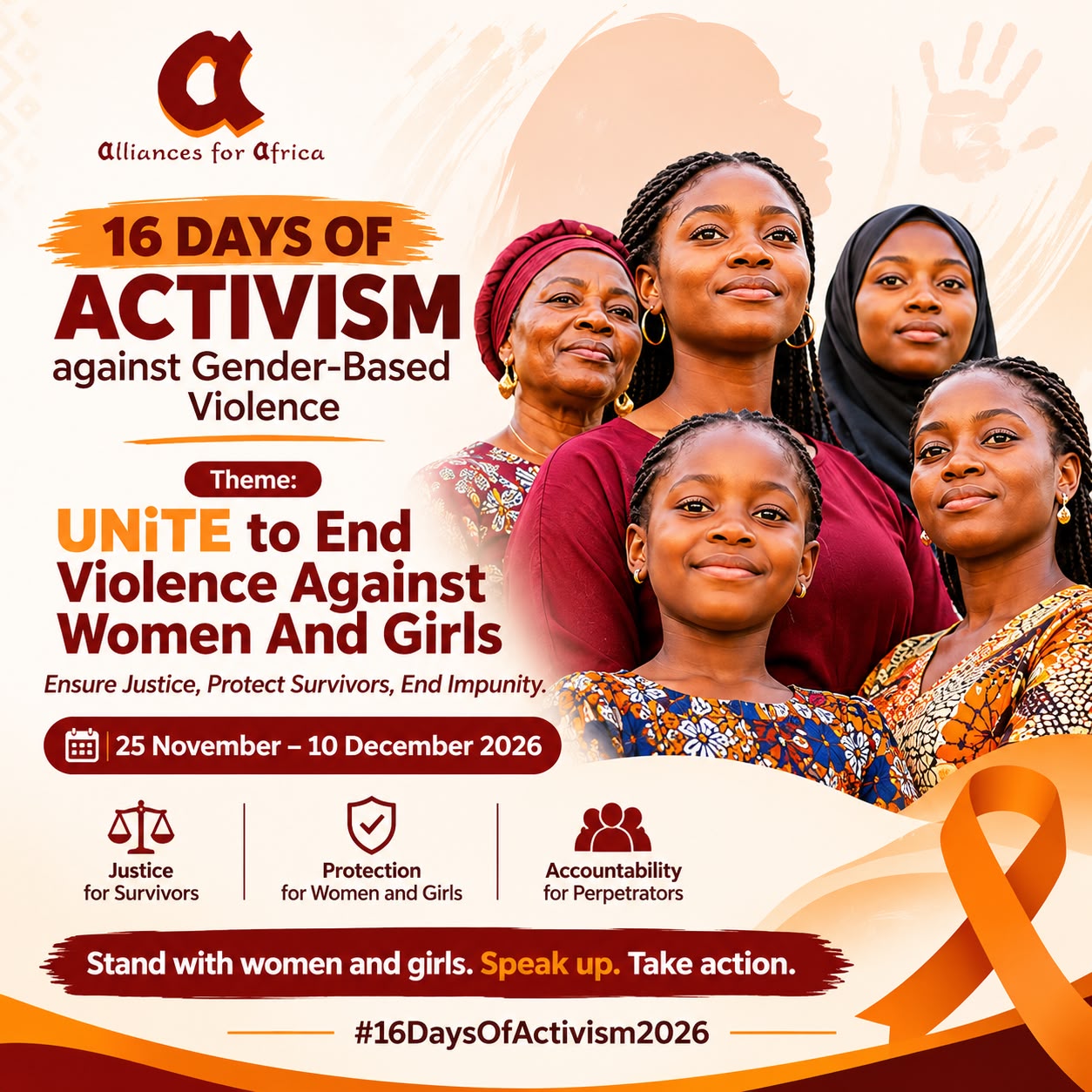
As the world marks the 2026 16 Days of Activism Against Gender-Based Violence, Alliances for Africa (AfA) calls on governments, institutions, traditional and religious leaders, and communities to move beyond statements of commitment and take decisive action to end violence against women and girls. Under this year’s theme, “UNiTE to End Violence Against Women and Girls: Ensure Justice, Protect Survivors, End Impunity,” AfA reiterates that ending gender-based violence requires more than condemnation. It demands effective laws, accountable institutions, accessible support services, and a society that refuses to tolerate violence in any form.
Across Nigeria, women and girls continue to experience multiple and intersecting forms of gender-based violence, including domestic and sexual violence, Female Genital Mutilation (FGM), child and forced marriage, harmful widowhood practices, and economic abuse. These violations occur in homes, communities, and public spaces, often sustained by unequal power relations, harmful gender norms, economic dependence, silence, and institutional failures.
Too often, survivors are discouraged from speaking out, pressured to settle cases privately or blamed for the violence committed against them. Meanwhile, perpetrators continue to evade accountability, sometimes shielded by family members, influential individuals, and community institutions.
AfA maintains that no cultural belief, religious interpretation, family expectation, or traditional practice should be used to justify violence, control women’s bodies, or deny women and girls their fundamental human rights. Traditions that expose women and girls to harm must be challenged and transformed, regardless of how deeply rooted they may be in society.
We recognise that violence against women and girls is not simply a private or isolated matter. It is rooted in structural inequalities and systems of power that continue to restrict women’s autonomy, silence their voices and undermine their rights. Ending this violence therefore requires confronting the social norms, institutional practices, and power structures that enable it to persist.
Speaking on the importance of this year’s campaign, Iheoma Obibi, Executive Director of Alliances for Africa, stated:
“We cannot continue to speak about ending violence against women and girls while those responsible are allowed to escape accountability. A woman who reports abuse should not be made to feel ashamed, blamed, or abandoned. She deserves to be heard, protected, and given access to justice. We need laws that work, institutions that take responsibility, and communities that refuse to make excuses for violence. Until perpetrators are held accountable and survivors receive the protection and support they deserve, our response to gender-based violence remains inadequate. Silence protects perpetrators; accountability protects survivors.”
Stressing the importance of challenging harmful traditional practices, Juliet Okeiyi, a women’s community advocate, emphasised:
“Traditions should be a source of pride, not a reason for pain. As women, we have the right to live with dignity, make decisions about our bodies and raise our daughters free from harmful practices. We must question and transform the beliefs and social expectations that allow these practices to continue. Culture should evolve in ways that protect people’s dignity and rights, not deny them.”
Nigeria has clear regional and national obligations to protect women and girls from violence. The Maputo Protocol, particularly Article 5, requires States Parties to prohibit and eliminate harmful practices that negatively affect the human rights of women. Similarly, the Violence Against Persons (Prohibition) Act provides an important legal framework for addressing violence and protecting survivors. However, legal commitments and policy frameworks mean little when they are not effectively implemented. Laws must be translated into accessible justice, meaningful protection, and consequences for those who violate women’s and girls’ rights.
As part of the 2026 16 Days of Activism, AfA is calling for action in three critical areas:
- AfA calls on the Federal and State Governments to strengthen the implementation of the Violence Against Persons (Prohibition) Act and other relevant laws addressing gender-based violence. Cases of abuse must be promptly and effectively investigated, and perpetrators must be held accountable, regardless of their social status, wealth, political influence, or relationship with the survivor. Law enforcement agencies and justice institutions must be equipped and held responsible for responding appropriately to reports of violence. Justice must not depend on a survivor’s ability to pay, social standing or access to influential individuals.
- Governments must invest in accessible, adequately funded and survivor-centred services, including safe shelters, medical care, psychosocial support, counselling and legal assistance. Survivors must be treated with dignity, their privacy protected and their experiences taken seriously. Reporting violence should never expose survivors to further abuse, intimidation, discrimination or victim-blaming. Every woman and girl who experiences violence deserves to be heard, believed, supported and given access to justice without fear.
- AfA calls on governments, traditional and religious institutions and community leaders to take a firm stand against FGM, child and forced marriage, harmful widowhood practices and all other customs that violate the rights and dignity of women and girls. Governments must fully implement their obligations under Article 5 of the Maputo Protocol, while traditional and religious leaders must use their influence to challenge harmful beliefs and practices rather than reinforce or excuse them. Communities must recognise that preserving cultural identity does not require preserving practices that cause harm.
- Governments must invest in accessible, adequately funded and survivor-centred services, including safe shelters, medical care, psychosocial support, counselling and legal assistance. Survivors must be treated with dignity, their privacy protected and their experiences taken seriously. Reporting violence should never expose survivors to further abuse, intimidation, discrimination or victim-blaming. Every woman and girl who experiences violence deserves to be heard, believed, supported and given access to justice without fear.
As the 16 Days of Activism unfolds, AfA reminds all stakeholders that the fight against gender-based violence cannot be confined to a sixteen-day campaign. It requires sustained political commitment, institutional accountability, adequate resources, and collective action throughout the year. Governments must fulfil their obligations, institutions must respond to violations, community leaders must challenge harmful norms, and individuals must refuse to tolerate or excuse abuse.
Women and girls should not have to negotiate for their safety, defend their dignity or beg for justice. Violence is never a cultural entitlement, and impunity must never be the price survivors pay for speaking out.
This 16 Days of Activism, AfA calls for more than solidarity. We call for action, accountability, and justice.
About Alliances for Africa (AfA)
Alliances for Africa (AfA) is a feminist-led human rights, peace, and sustainable development organisation dedicated to advancing gender equality, protecting human rights, and promoting social justice through strategic partnerships and community-led action. AfA works to dismantle systemic barriers that prevent women, girls, and marginalised groups from achieving full equality.
Media Contact:
Diana Ginika, Communications and Storytelling Officer
Phone No: 07059843599
YouTube: @alliancesforafrica9554
TikTok: @alliances.for.Africa
LinkedIn: Alliances for Africa
X: AfAafrica
Instagram: alliancesforafrica
Website: www.alliancesforafrica.org
Facebook: AlliancesforAfrica