Strengthening Safeguarding for Every Child
In July 2026, a Punch report highlighted conditions at Imo State Secondary School for the Deaf in Ofekata Orodo, Mbaitoli Local Government Area. Beyond concerns about deteriorating facilities, the report revealed serious security gaps, including a breached perimeter fence and the absence of adequate security personnel. A caregiver told the newspaper that female students had reportedly been sexually assaulted by intruders who gained access to the school. The Imo State Commissioner for Primary and Secondary Education confirmed the breach in the school’s perimeter fence and said officials were taking steps to improve security.
This situation raises an important question: what does it mean for a child to attend school when the very environment meant to protect them exposes them to harm?
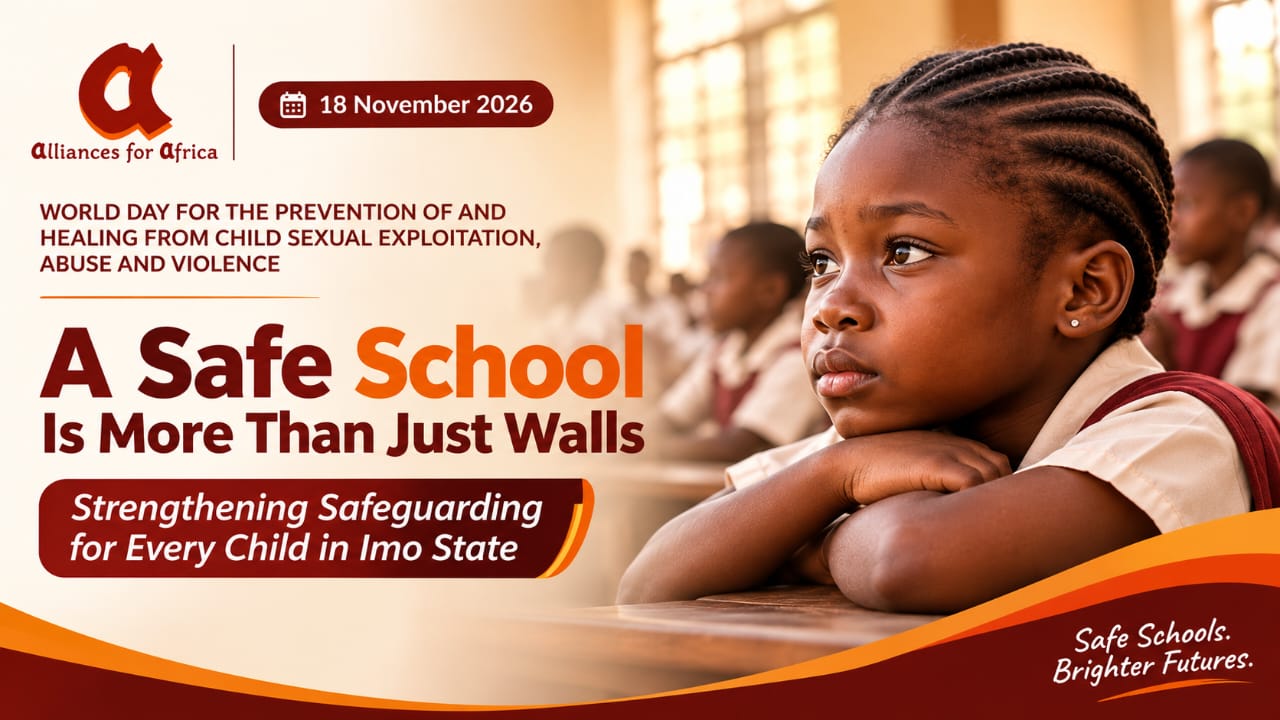
A school building, a locked gate, or the presence of security personnel does not automatically make a school safe. A safe school is one where children are protected from abuse, exploitation, harassment, and violence, where their concerns are taken seriously, and where they can learn without fear. The situation reported at the School for the Deaf illustrates how weaknesses in physical security can expose children to danger, while also highlighting the need to consider the protection needs of children with disabilities.
The threats children face in school environments are not limited to intruders or strangers. Abuse can also come from within the school community, including teachers, other employees, and fellow pupils/students. It may take the form of unwanted touching, sexual comments, inappropriate messages, bullying, physical punishment, verbal humiliation, or the misuse of authority. An adult may exploit a child’s dependence by offering academic favours, money, or other benefits in exchange for sexual attention or acts. A child may also be threatened, blamed, or intimidated into remaining silent after experiencing inappropriate behaviour.
These are not simply disciplinary issues or misunderstandings. They are safeguarding concerns that require appropriate prevention, reporting and response mechanisms. When a child reports abuse and is dismissed, blamed or threatened, the harm can deepen, while other children may become less willing to speak up.
The scale of violence against children in Nigeria makes these concerns particularly urgent. Findings from the 2014 Nigeria Violence Against Children Survey show that 24.8% of females and 10.8% of males aged 18–24 experienced sexual abuse before the age of 18. The survey also found that approximately six in ten children experienced at least one form of physical, sexual, or emotional violence before adulthood. These figures demonstrate that violence against children is not an isolated concern and that both girls and boys require protection.
Evidence from the 2024 Situation Analysis of Children and Adolescents in Nigeria further highlights the school environment as an important setting in the discussion of sexual violence. The report found that 15% of girls and 25% of boys reported that their first experience of sexual violence occurred at school. This finding questions the assumption that school is automatically a safe environment and reinforces the need for effective protection systems in every learning institution.
For Imo State, these findings raise important questions about how schools prevent abuse, respond to complaints, and protect children who disclose harmful experiences. The Federal Ministry of Education’s 2024/2025 Annual School Census lists 4,279 schools in the state, comprising 1,943 public and 2,336 private schools. However, the census portal records a reporting rate of 64%, with 2,740 schools reported. This stresses the need to strengthen both school monitoring and the availability of reliable information on learning environments across the state.
Nigeria already has a policy framework to guide school safety. The 2021 National Policy on Safety, Security and Violence-Free Schools, together with its Minimum Standards for Safe Schools, establishes expectations for creating learning environments that protect children from violence and other threats. These standards recognise that school safety involves more than infrastructure; it requires prevention, clear responsibilities, reporting mechanisms, appropriate responses and the participation of relevant stakeholders.
However, the existence of these policies does not automatically guarantee their implementation. A safeguarding policy that staff do not understand or that is not reflected in everyday school practices offers little protection to a child who needs help. Schools must therefore move beyond having policies on paper to establishing systems that work in practice.
In Imo State, this means that public and private schools should have clear safeguarding procedures outlining acceptable staff conduct, professional boundaries, reporting channels, confidentiality and referral pathways for children who experience abuse. There must also be transparent procedures for handling allegations involving teachers, school employees, and administrators. No allegation should be ignored or handled in a way that prioritises an institution’s reputation over a child’s safety.
School administrators also have a responsibility to ensure that staff members understand safeguarding standards and know how to respond appropriately to concerns. Designated safeguarding personnel should receive relevant training, while children should be taught, in age-appropriate ways, to recognise inappropriate behaviour, understand their rights and identify trusted adults they can approach for help. Reporting channels must be accessible, child-friendly and safe, with clear steps for referring cases to appropriate child protection and support services.
Children’s experiences of abuse and their ability to report it may also be influenced by gender, disability and social expectations. Girls may face victim-blaming, shame or pressure to remain silent, while boys may fear ridicule or disbelief because of expectations that they should always appear strong. Children with disabilities may encounter communication, accessibility and other barriers that make it harder for them to disclose abuse or have their concerns heard. Safeguarding systems must recognise these differences and ensure that every child can seek help and receive protection with dignity.
Parents and caregivers also have a role to play. Knowing who children can approach when they feel unsafe, understanding how their schools handle complaints, and taking disclosures seriously can help create an environment in which children feel supported. When a child speaks about an uncomfortable or harmful experience, the first response must be to listen, reassure them that they are not to blame, and seek appropriate support rather than dismissing their concerns.
Ultimately, a safe school is not defined by the strength of its walls or the security of its gates but by how it treats the children within them, how it responds when harm occurs, and what it does to prevent that harm from happening again. A school that teaches children to read, write, and prepare for the future must also teach them that their bodies, voices, and rights matter.
Every child deserves to enter a classroom without fear, learn without intimidation, and speak up without worrying that doing so will put them in further danger.